
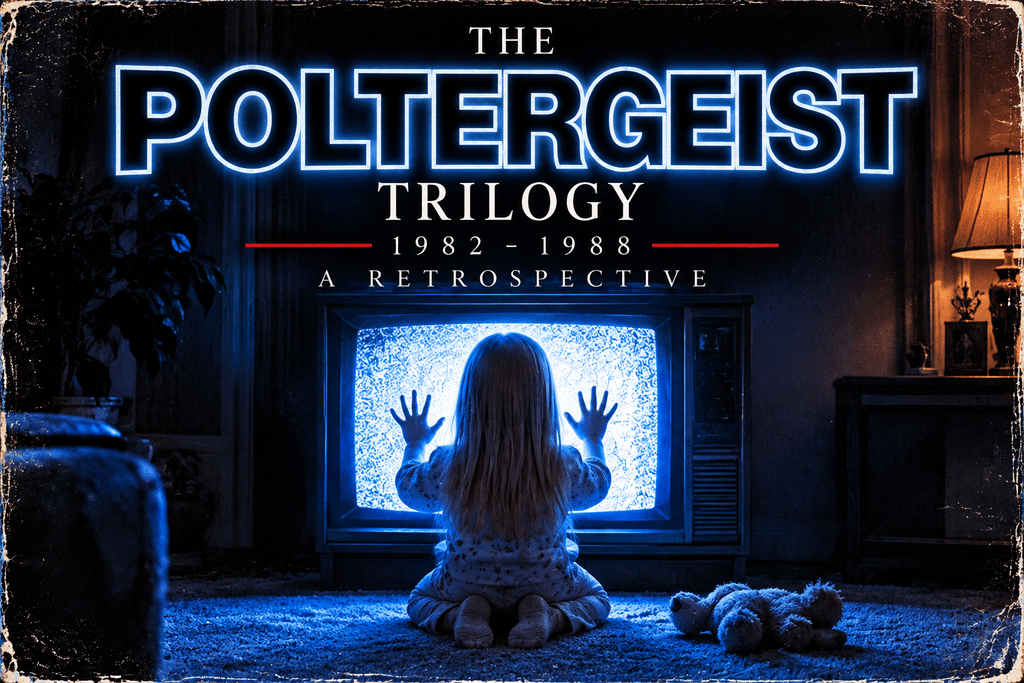
There’s something almost perfectly 1980s about the opening of Poltergeist. The television is on. The family is asleep. The dog wanders the house looking for snacks. And before long, five-year-old Carol Anne Freeling is standing in front of a television set talking to something nobody else can see.
“They’re here.”
The line escaped the movie entirely. But what makes Poltergeist interesting more than four decades later isn’t the creepy kid staring into static, it’s that the original trilogy turned out to be a surprisingly revealing time capsule. Across Poltergeist (1982), Poltergeist II: The Other Side (1986) and Poltergeist III (1988), the series changes directors, locations, visual styles and even its basic conception of what is haunting Carol Anne. What begins as an unusually intimate story about a suburban family whose home turns against them becomes supernatural mythology, then an urban ghost story built on mirrors, reflections and isolation.
Behind all of it sits one of the stranger creative histories in 1980s horror.
Something Was Wrong in Cuesta Verde
The first Poltergeist doesn’t begin in a creepy Victorian mansion. No wrought-iron gates, no foggy graveyard, no mysterious inheritance from a dead relative. The Freelings live in Cuesta Verde, a new California housing development of nearly identical homes, freshly planted lawns and families who have achieved a recognizable version of the American middle-class dream.
That choice puts the film squarely inside a developing strain of suburban horror. Film scholarship has connected it with early-1980s anxieties about suburbia, the nuclear family and the supposed security of middle-class American life, the idea that whatever frightens us might already be underneath the neighborhood.
Poltergeist takes that almost literally. Steve Freeling doesn’t merely live in Cuesta Verde. He sells houses there. His family has bought in financially and emotionally, which is why the eventual revelation about what sits beneath the development works as more than a horror-movie twist. The beautiful new neighborhood was built by people who believed the past could simply be moved out of the way.
The past had other ideas.
Spielberg, Hooper and Poltergeist
You can’t talk about Poltergeist without talking about Steven Spielberg and Tobe Hooper. Spielberg produced and shares screenplay credit with Michael Grais and Mark Victor. Hooper, already famous for The Texas Chain Saw Massacre, took the directing credit. AFI’s production records list Hooper as director, Spielberg and Frank Marshall as producers, and Spielberg, Grais and Victor as writers.
Almost from the beginning, questions circulated about how that collaboration actually worked, and those questions became part of the movie’s mythology. The debate shouldn’t be flattened into the old claim that Spielberg secretly directed it. Contemporary reports and later recollections describe something messier and more collaborative, with Spielberg heavily involved as writer-producer while Hooper remained the credited director. The Directors Guild of America got involved after concerns that MGM’s marketing emphasized Spielberg in a way that diminished Hooper’s credit, and film scholarship still treats the authorship question as central to the movie’s history.
Maybe the debate refuses to die because it’s right there on the screen. Poltergeist feels like both filmmakers.
There is the Spielbergian suburban family, children at the center, ordinary household objects turning magical and terrifying, wonder sitting beside fear. And then there’s something nastier underneath it: the swimming pool full of corpses, the man tearing his own face apart in the bathroom mirror, the skeletal apparition guarding the children’s bedroom. The sense that underneath the clean surface of American life there is something rotten waiting to come through. That’s not far from the worldview of the man who made The Texas Chain Saw Massacre.
Roger Ebert noticed the unusual combination when the film opened, writing that its effectiveness came less from spectacle than from Hooper and Spielberg filtering the supernatural through the family’s experience. That’s probably the secret. For all the ghosts, portals and effects work, the Freelings behave like a family.
Horror Comes Home
There’s another piece of Poltergeist that’s easy to overlook now: the movie was rated PG, and getting there wasn’t straightforward. AFI’s records show the film initially received an R before MGM successfully appealed. Spielberg argued for an intermediate rating between PG and R, an idea that became considerably more relevant a couple of years later when PG-13 was created.
That rating helps explain the movie’s place in pop culture. This wasn’t horror confined to the grindhouse. It was a big summer movie, opening June 4, 1982, days before Spielberg’s E.T. the Extra-Terrestrial. Contemporary coverage inevitably paired the two, and Poltergeist became a major commercial success, with AFI recording an eventual worldwide gross of roughly $122 million. For a closer look at the film itself, revisit Poltergeist (1982) in our VHS Vault.
Critics largely understood what they were seeing. Ebert called it an effective thriller; Vincent Canby’s New York Times review described a remarkably spooky ghost story while noting the difficulty of separating Hooper’s contribution from Spielberg’s. That reputation has held. Rotten Tomatoes currently records an 89 percent critics score from 80 reviews, with the consensus calling it a modern horror classic.
The sequels would have a much harder road.
Four Years Later
Four years later the Freelings came back. Their house didn’t.
That left Poltergeist II: The Other Side with an interesting problem, because the first movie had destroyed its haunted house. What is a Poltergeist movie without Cuesta Verde?
Grais and Victor returned as writers and became producers. According to AFI’s production history, the studio approached them about a sequel after the original’s success, and they chose to continue the Freelings’ story rather than build another haunted-house movie around unrelated characters. That decision reframes the entire franchise. The first movie is something is wrong with this house. The second becomes something wants Carol Anne. Very different kind of horror story.
That shift in direction is part of what makes Poltergeist II: The Other Side (1986) such an interesting entry in our VHS Vault, even when the sequel struggles to recapture the original’s magic.
The Man at the Door
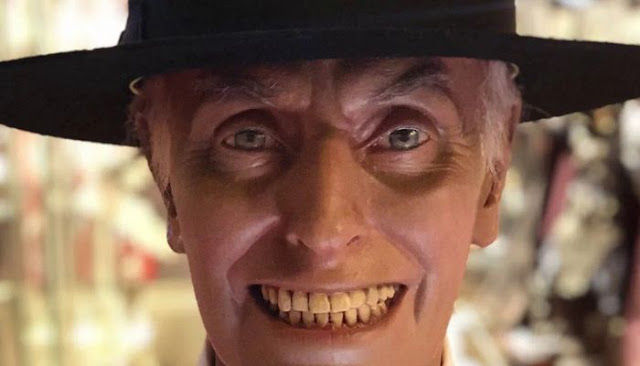
If Poltergeist II has one contribution everybody remembers, it’s Reverend Henry Kane.
Julian Beck’s performance works because Kane doesn’t look like the kind of monster these movies had taught us to expect. He’s an old man. He smiles. He sings. He stands outside the family’s home politely asking to be invited in. And he is absolutely terrifying.
Kane also gives the threat something the first movie deliberately withheld: a face and a history. The sequel explains that he led an apocalyptic religious cult and ties his followers to the spirits trapped beneath Cuesta Verde. Whether that explanation was necessary is another question — there’s real power in the original’s ambiguity, where we understand enough about what happened under the development without an elaborate mythology.
Poltergeist II wants answers, which is a very sequel-like instinct. The mysterious force becomes Kane. The nameless evil becomes the Great Beast. The family’s ordeal becomes one front in a larger spiritual conflict. And the visual language changes right along with it.
Giger’s Other Side
The sequel brought in another fascinating creative force: H. R. Giger. By 1985, his biomechanical designs for Alien had made him one of the most recognizable visual artists in science-fiction and horror cinema. MGM commissioned him to develop concepts for Poltergeist II, including manifestations of the Great Beast; Giger’s own biographical records confirm the 1985 commission, while AFI documents how those designs were translated into physical creature effects by Steve Johnson and the Boss Film team.
The result pushes the series toward body horror where the original had been spectral. Steve swallowing the tequila worm and subsequently vomiting a grotesque creature is the clearest example. It’s weird, it’s disgusting, and it’s a long way from Carol Anne talking to television static.
That’s Poltergeist II in miniature: more mythology, more creatures, more explanations, more supernatural rules. Yet its strongest material may still be the simplest, the Freelings trying to remain a family afterward. Their house is gone. Their possessions are gone. Their insurance company isn’t buying the explanation that the home departed into another dimension. There’s something funny and melancholy in that. They survived the haunted house; now they have to survive the aftermath.
Living in the Shadow of Poltergeist
Contemporary critics noticed the second film couldn’t escape comparison with its predecessor. The Los Angeles Times review practically built its argument around the problem, describing a sequel struggling beneath the shadow of the first and specifically noting the absence of Spielberg and Hooper.
Brian Gibson was directing now, and while Poltergeist II retains the Freelings and some of the original’s emotional structure, it doesn’t have the same strange balance of domestic comedy, childhood wonder and sudden horror.
But time has been kind to Kane. Julian Beck created the rare sequel villain who became inseparable from the franchise’s identity despite never appearing in the original. Once you’ve seen him walking slowly toward that house singing “God Is in His Holy Temple,” it’s hard to imagine Poltergeist mythology without him.
Kane’s place in horror history deserves a closer look. In The Scariest Character in a Horror Trilogy: Reverend Kane, we explore how Julian Beck turned a seemingly harmless old preacher into one of the most unsettling figures in 1980s horror.
From Cuesta Verde to Chicago
Two years later the franchise made its strangest move. Carol Anne went to Chicago, most of the Freelings vanished from the story, and the suburbs were replaced by glass, steel and mirrors.
Gary Sherman, whose earlier work included Death Line and Dead & Buried, directed and co-wrote, shooting around Chicago and making prominent use of the John Hancock Center. This isn’t just a change of scenery; it’s a different theory of what a Poltergeist movie should look like. The first film is horizontal suburbia: lawns, bedrooms, closets, neighboring houses. The third goes vertical. Elevators, parking garages, high-rise apartments, mirrored hallways, glass everywhere.
Carol Anne isn’t surrounded by her immediate family either. She’s living with her aunt Pat, uncle Bruce and cousin Donna. That matters, because Poltergeist had been built on the idea that when something impossible happens, the Freelings close ranks. Here she’s isolated, and the movie feels colder for it.
The Mirrors Are the Movie
Whatever its problems, Poltergeist III‘s practical effects deserve another look. Sherman was fascinated by achieving effects physically and manipulating reflections in-camera rather than solving them optically afterward; in later interviews, he discussed his background in practical and photographic effects and his enthusiasm for elaborate tracking shots and camera tricks.
That obsession is everywhere in the film. Reflections move when people don’t. Characters appear inside mirrors. Entire spaces seem to exist on the wrong side of the glass.
Where the first Poltergeist turned ordinary suburban objects into threats, the television, the closet, the backyard, the third makes modern architecture itself unreliable. Cuesta Verde hid its dead underground. The Chicago skyscraper hides nothing; it’s all glass, you can see everything, and somehow you still can’t trust what you’re looking at. That’s a good Poltergeist idea.
By 1988, Things Were Different
By 1988 the series no longer occupied the place in popular culture it had six years earlier. Freddy Krueger had become a pop-culture phenomenon, Jason Voorhees was deep into his franchise run, and home video had rewired how horror circulated. Poltergeist III arrived feeling less like a cinematic event than like another late-1980s horror sequel. The Los Angeles Times argued it existed largely because the franchise name still carried commercial value.
There’s another reason the third movie is difficult to discuss purely as a movie. Heather O’Rourke died on February 1, 1988, during post-production. She was twelve years old, and the finished film was dedicated to her. Sherman later spoke openly about how devastating her death was and how profoundly it changed his feelings about completing the film.
That tragedy has also fed decades of sensational stories about a supposed “Poltergeist curse,” stories that turn real human loss into franchise mythology. They aren’t necessary. Heather O’Rourke’s presence in these movies speaks for itself.
Carol Anne Was the Franchise
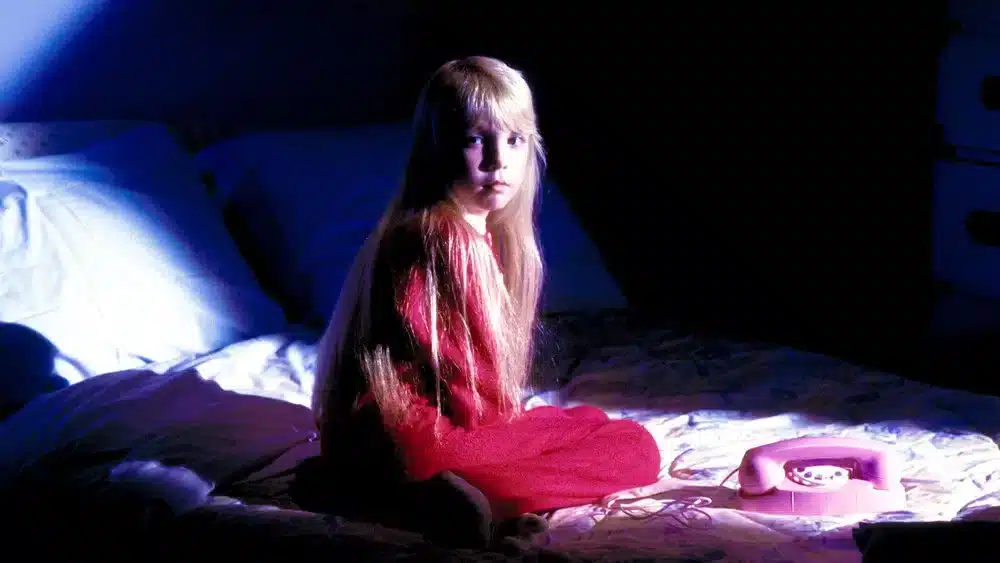
Watching the trilogy whole reveals something that wasn’t obvious in 1982: Carol Anne gradually becomes the center of Poltergeist. In the first film the Freelings are the protagonists. In the second she becomes increasingly load-bearing to the mythology. By the third she essentially is the franchise.
The house is gone. Spielberg is gone. Hooper is gone. Most of the Freelings are gone. Tangina remains, Kane remains in altered form, and Carol Anne remains. That’s the connective tissue.
And O’Rourke had an unusual quality for these movies. She didn’t play Carol Anne like a miniature horror-movie adult. She seemed like a kid, and that innocence made everything supernatural around her feel stranger.
What Remains
Seen together, the original trilogy isn’t three variations on one movie; it’s three different fears.
The first is about home: what if the safest place in your world isn’t safe? The second is about history: what if destroying the haunted house doesn’t destroy whatever created the haunting? The third is about perception: what if you can’t trust your own reflection?
That wasn’t some grand trilogy plan. The production histories suggest nearly the opposite. Different filmmakers repeatedly trying to figure out where Poltergeist could possibly go after a first movie that had already blown up the house and finished the story. Which is exactly why the evolution is interesting. Each sequel solves the problem differently, and the series becomes smaller, stranger and less culturally dominant as it goes.
But everything still circles back to 1982, because the original caught something that couldn’t be manufactured again: Spielberg’s fascination with childhood, Hooper’s darker instincts, Jerry Goldsmith’s score, Richard Edlund’s effects, JoBeth Williams and Craig T. Nelson playing parents rather than horror-movie victims, Zelda Rubinstein walking in halfway through and making Tangina instantly iconic. And Heather O’Rourke sitting in front of that television.
It also arrived at exactly the right cultural moment, when suburbia could still stand for safety and success while becoming fertile ground for filmmakers who wanted to ask what was hiding underneath that image. Which is why the final revelation still lands so well. The developer didn’t move the cemetery. He moved the headstones. The whole film turns into a joke about shortcuts, greed and the American habit of building something new without dealing honestly with what was already there. The Freelings thought they’d bought a house. They’d bought somebody else’s buried history.
Poltergeist begins in 1982 with a little girl kneeling in front of the family television while everyone sleeps around her. By 1988, that same girl is wandering a world of mirrors where reality itself can’t be trusted. Technology changes. The houses change. The filmmakers change. Even the monsters change. But the series keeps returning to one uncomfortable idea; we build places to make ourselves feel safe. A house. A neighborhood. A family. A skyscraper.
And then horror asks the question it has always been best at asking: what happens when the thing you trusted to protect you lets something in?